
How to Find the Best Rehabs in the World?
Choosing a rehab facility is one of the most consequential decisions a person or family will ever make. It is not simply about picking a place with comfortable rooms or a scenic location. The right treatment environment can shape whether someone builds a lasting recovery or cycles through repeated relapses. With luxury rehab options now available across dozens of countries, from coastal retreats in Malibu to private clinics in the Swiss Alps, the choice has never been more complex or more important.
Families researching options today are met with a flood of websites, glowing testimonials, and marketing language that can make almost any facility sound exceptional. The real differences between an average program and an outstanding one are often buried in details that aren’t obvious at first glance: clinical staffing ratios, accreditation status, the depth of aftercare planning, and how a program handles co-occurring mental health conditions.
This guide walks through exactly what separates the best rehab centers in the world from the rest. It covers the clinical standards that matter, how luxury treatment differs from standard care, what to ask before committing to a program, and which countries have become known for world-class addiction and mental health treatment.
Why Choosing the Right Rehab Matters
According to the 2024 National Survey on Drug Use and Health, released by SAMHSA in July 2025, 16.8% of people aged 12 and older in the United States, or 48.4 million people, had a past-year substance use disorder (SAMHSA, 2024 NSDUH). Of that group, 27.9 million had an alcohol use disorder and 28.2 million had a drug use disorder, with marijuana use disorder remaining the most common at 20.6 million cases. Encouragingly, only about 1 in 5 people who needed treatment (19.3%) actually received it last year, which underscores why getting the choice of facility right matters so much when someone finally does seek help.
There is also genuine momentum on the public health side. CDC’s most recent provisional data shows an estimated 69,973 drug overdose deaths nationwide in 2025, down almost 14% from 81,313 in 2024, marking the third consecutive year of decline (CDC/NCHS, May 2026). That trend reflects real progress, but it doesn’t reduce the stakes for any individual family weighing where to seek care.
Treatment success considerations. A program’s clinical model needs to match the person entering it. Someone with a long history of relapse, severe trauma, or a co-occurring psychiatric diagnosis needs a fundamentally different level of care than someone entering treatment for the first time.
Personalized care importance – Generic, one-size-fits-all programs tend to underperform. Individualized treatment planning that accounts for someone’s medical history, trauma background, and personal goals consistently produces better engagement than identical schedules applied to every client.
Long-term recovery outcomes – Recovery is measured in years, not weeks. A facility that focuses only on the days someone spends on-site, without building a bridge to ongoing care, is setting clients up for a harder transition home.
Family involvement – Addiction rarely affects only the individual. Programs that bring family members into the treatment process tend to support more stable home environments after discharge.
Mental health support – Per the same 2024 NSDUH data, 23.4% of U.S. adults, about 61.5 million people, experienced a mental health condition in the past year, and 5.6% (14.6 million) experienced a serious mental illness. Among people with substance use disorders, co-occurring depression, anxiety, or PTSD is common rather than rare. A rehab that treats addiction in isolation, without addressing the psychiatric conditions driving it, often sees clients relapse soon after leaving.
Ready to Find the Right Center for You?
What Defines the Best Rehab Centers in the World?
Accreditation and Licensing
Accreditation is the single most reliable signal of quality you can check before anything else. Two organizations set the bar in the addiction and behavioral health space: The Joint Commission and the Commission on Accreditation of Rehabilitation Facilities (CARF).
The Joint Commission evaluates healthcare organizations against rigorous, evidence-based performance standards. CARF accreditation focuses specifically on rehabilitation and human services programs, assessing whether a facility’s treatment practices align with proven, outcome-driven methods. Accreditation requires facilities to submit to independent surveys and demonstrate measurable outcomes, rather than simply making claims on a website.
Evidence-Based Treatment Programs
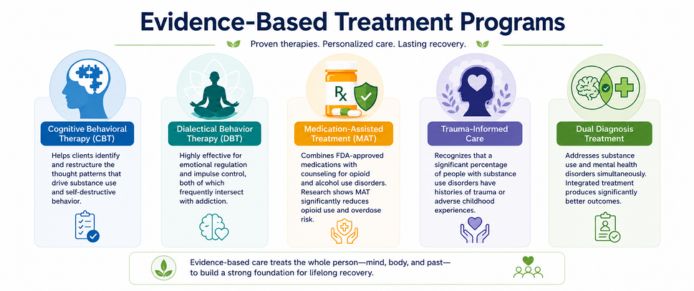
The best rehab centers build their clinical programming around therapies with a strong research base.
- Cognitive Behavioral Therapy (CBT) helps clients identify and restructure the thought patterns that drive substance use and self-destructive behavior.
- Dialectical Behavior Therapy (DBT) is highly effective for emotional regulation and impulse control, both of which frequently intersect with addiction.
- Medication-Assisted Treatment (MAT) combines FDA-approved medications with counseling for opioid and alcohol use disorders. NIDA research shows MAT reduces opioid use and overdose risk far more effectively than abstinence-only approaches for many patients.
- Trauma-informed care recognizes that a significant percentage of people with substance use disorders have histories of trauma or adverse childhood experiences.
- Dual diagnosis treatment addresses substance use and mental health disorders simultaneously. Mayo Clinic notes that integrated treatment for co-occurring disorders produces significantly better outcomes than treating each condition separately.
Experienced Clinical Team
- Psychiatrists should be board-certified and directly involved in diagnosis and medication management.
- Addiction specialists bring specific expertise in detox protocols and relapse prevention.
- Therapists should hold relevant licensure (LCSW, LMFT, LPC, or equivalent) with specific training in modalities like CBT, DBT, or EMDR.
- Medical staff, including nurses and physicians available around the clock, are essential for safe detox.
Personalized Treatment Planning
The best programs conduct a comprehensive intake assessment, including a full psychiatric evaluation, medical history review, and trauma screening, then build a tailored plan that’s adjusted as the person progresses.
Continuum of Care and Aftercare
The strongest programs build a clear continuum, often progressing from medical detox to residential treatment, then a partial hospitalization program, an intensive outpatient program, and ongoing outpatient support. Longer engagement in structured care is consistently linked with lower relapse rates.
Luxury Rehab vs Standard Rehab
| Factor | Standard Rehab | Luxury Rehab |
|---|---|---|
| Privacy | Shared rooms common, limited confidentiality controls | Private rooms or suites, strict confidentiality protocols |
| Accommodation | Basic, clinical, dormitory-style | Resort-style settings, private chefs, high-end furnishings |
| Staff-to-client ratio | Often high client-to-staff ratios | Low ratios, frequently near one-to-one or small group care |
| Therapy access | Group therapy emphasis, limited individual sessions | Daily individual therapy alongside group work |
| Amenities | Minimal recreational options | Pools, fitness centers, equine therapy, private outdoor space |
| Wellness services | Rarely included | Massage therapy, acupuncture, nutrition counseling, yoga |
| Aftercare support | Referral lists, limited follow-up | Structured alumni programs, ongoing case management |
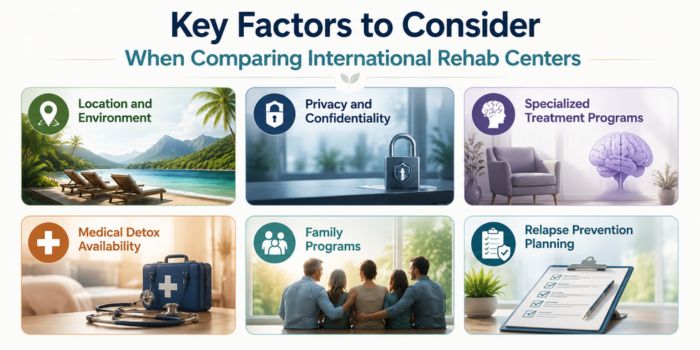
Key Factors to Consider When Comparing International Rehab Centers
Location and Environment
Beach retreats, mountain retreats, countryside settings, and urban private facilities each suit different personalities. There is no universally “best” environment; the right setting depends on what helps a specific individual feel safe enough to do difficult emotional work.
Privacy and Confidentiality
For executives and public figures, the best international facilities have strict non-disclosure protocols, secure communications, and sometimes entirely separate private villas away from the main facility.
Specialized Treatment Programs
Look for centers with documented experience treating the specific issue at hand: alcohol addiction, drug addiction, prescription medication dependency, trauma, anxiety, depression, burnout, or executive stress.
Medical Detox Availability
Detox is the most medically vulnerable stage of treatment, particularly for alcohol and benzodiazepine withdrawal. The best facilities have on-site medical detox with 24-hour nursing and physician oversight.
Family Programs
Family weeks and structured therapy sessions involving loved ones are hallmarks of programs that understand addiction as a family system issue, not just an individual one.
Relapse Prevention Planning
NIDA notes that relapse rates for substance use disorders range from roughly 40 to 60 percent, a pattern comparable to relapse rates seen in other chronic illnesses like hypertension and asthma. That rate drops considerably the longer someone stays engaged in continuing care, which is exactly why the best programs build detailed relapse prevention plans well before discharge.
Countries Known for World-Class Luxury Rehab Centers
United States – A global leader in addiction treatment infrastructure, with deep clinical research and decades of program development. California offers a wide range of luxury options, from Malibu coastal retreats to private estates around Los Angeles and San Diego.
Switzerland – Known for clinical precision and absolute discretion, combining rigorous medical oversight with serene alpine settings.
Thailand – A major destination for affordable luxury treatment, offering resort-style facilities at a fraction of Western costs while maintaining international clinical standards.
Spain – Combines Mediterranean climate with a growing number of private, often bilingual, clinics.
Portugal – Known for holistic, integrative approaches combining clinical therapy with wellness practices like surfing therapy and nutrition-focused recovery.
United Kingdom – A strong network of private psychiatric and addiction clinics, with London known for discreet, high-end treatment serving international clients.
South Africa – Expansive private estates, lower relative costs, and a strong focus on nature-based therapies including equine-assisted programs.
The right country depends heavily on travel logistics, language, budget, and clinical specialization needed. Due diligence into a specific facility’s credentials matters more than the country it’s located in.
Questions You Should Ask Before Choosing a Rehab
- Is the facility accredited by the Joint Commission, CARF, or an equivalent recognized body?
- What licenses do the treating clinicians hold, and can you verify them independently?
- What is the staff-to-client ratio during both daytime and overnight hours?
- Does the facility offer on-site medical detox with 24-hour nursing coverage?
- How is the initial clinical assessment conducted, and who performs it?
- What evidence-based therapies are used, and how are they tailored to individual needs?
- Is dual diagnosis treatment available for co-occurring mental health conditions?
- What does a typical day or week of treatment actually look like?
- How does the facility handle medical emergencies or psychiatric crises on-site?
- What is the program’s approach to family involvement and education?
- What does aftercare planning include, and how far in advance is it developed?
- Are there documented outcome statistics, and how are they measured?
- What are the total costs, and what exactly is included versus billed separately?
- What confidentiality protocols are in place for high-profile clients?
- How does the facility handle insurance verification or international payment options?
- What is the average length of stay, and how is that decided for each client?
- Can you speak with alumni or read verified independent reviews of the program?
- What happens if a client wants to leave treatment early?
- Is there a structured plan for transitioning from residential care to outpatient support?
- What ongoing communication can families expect during treatment?
Warning Signs to Watch For
- Lack of accreditation. If a facility cannot clearly state its accreditation status, treat that as a serious concern.
- Unrealistic success claims. Be wary of any program promising guaranteed sobriety. No program can ethically guarantee outcomes given how relapse actually behaves clinically.
- Hidden pricing. Reputable facilities are upfront about costs and what is included.
- Poor transparency. Facilities reluctant to share clinical team or treatment details before admission are not operating with the openness families deserve.
- Limited clinical information. Push for specifics beyond marketing language like “holistic” or “transformative.”
- Weak aftercare planning. A facility that treats discharge as an afterthought is more likely to see clients relapse shortly after leaving.
How Find Luxury Rehab Simplifies the Search Process
Researching rehab options independently can be overwhelming, especially while managing the emotional weight of a personal crisis. Find Luxury Rehab operates independently, meaning it is not owned by or affiliated with any specific facility, which allows it to present information without bias toward one provider over another.
Its curated directory focuses specifically on luxury rehab centers, screened for quality indicators rather than aggregating every listing available. Because the directory spans multiple countries, users researching options in the United States can compare against centers elsewhere within the same search experience. Alongside the directory, the platform’s educational resources help users walk into conversations with facilities already informed, without ever needing to make contact before they’re ready.
Expert Tips for Finding the Best Rehab for Long-Term Recovery
Start with clinical fit, not amenities. Evaluate the treatment model first, then consider comfort.
Verify credentials independently. Look up accreditation status directly through the Joint Commission or CARF websites.
Ask about co-occurring disorder treatment specifically. Given how common dual diagnosis is, vague answers here should raise questions.
Involve family early when appropriate. Programs with structured family education tend to support more stable outcomes.
Plan for the full continuum, not just the first 30 days. The strongest outcomes come from sustained engagement across detox, residential care, and outpatient support.
Trust your instincts during initial conversations. How an admissions team communicates often reflects the culture of the clinical program itself.
Conclusion
Finding the best rehab in the world comes down to a handful of fundamentals: verified accreditation, evidence-based clinical programming, an experienced and properly credentialed treatment team, individualized care planning, and a genuine commitment to long-term aftercare. Luxury elements like privacy and comfort matter and can meaningfully support recovery, but they should enhance strong clinical care rather than substitute for it. Ask direct questions, verify credentials independently, and prioritize programs that treat the whole person rather than addiction in isolation.